🚨 Promo Ending Soon! Purchase your new signature while our limited-time deal is active.

Professional Identity in Motion: How Signatures Travel Across Modern Workflows
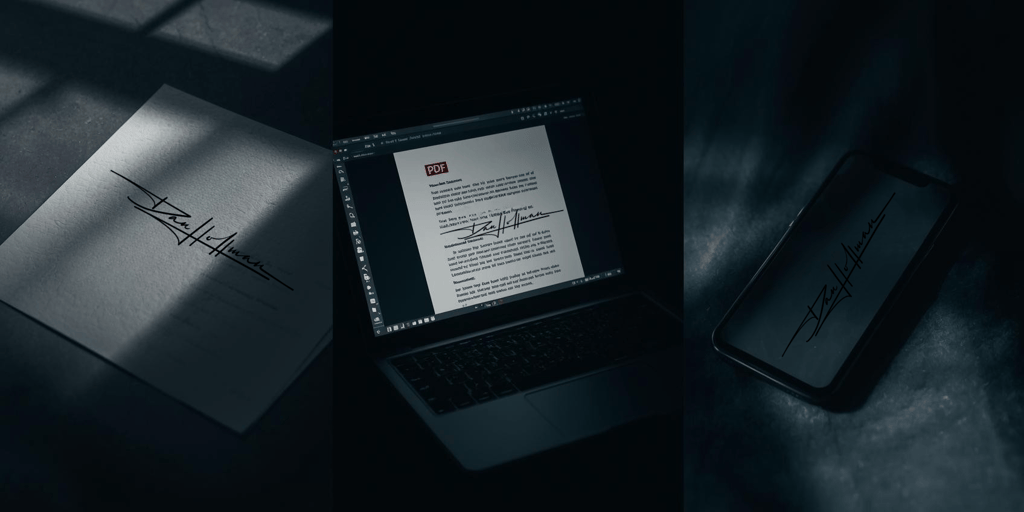
Modern professionals sign documents across multiple platforms—from paper contracts to digital agreements. Learn how maintaining a consistent signature across workflows reinforces professional identity and executive credibility.
3/15/20267 min read
The Evolution of Signatures in the Digital Age
In contemporary professional environments, the concept of signatures has undergone a remarkable transformation from traditional, ink-based symbols to sophisticated digital representations. Historically, signatures served as a personal identifier, establishing credibility and authenticity on paper documents. However, with the advent of technology, the need for faster and more efficient processes has led to the evolution of signatures into digital formats. This evolution reflects broader changes in how business transactions are conducted, particularly in the wake of a shift towards remote work and digital interactions.
Digital signatures now play a crucial role in various workflows, offering tools that not only streamline processes but also enhance security and accessibility. This transition allows individuals and organizations to sign documents electronically, thereby minimizing the reliance on physical paperwork. Additionally, digital signatures can incorporate advanced encryption methods, ensuring the integrity of the signed material and protecting against forgery. Thus, the modern digital signature embodies both convenience and security, aligning with the fast-paced nature of today’s work environments.
Despite these advancements, the importance of maintaining a consistent signature identity across various platforms remains pivotal. A cohesive signature identity reinforces brand integrity and promotes recognition in environments characterized by frequent digital communication. This consistency helps in establishing trust and professionalism, vital attributes in any business relationship. As we delve deeper into the implications and strategies surrounding digital signatures, it becomes clear that adopting a uniform approach to signature management is essential in navigating the complexities of modern workflows. Ultimately, understanding the evolution of signatures helps professionals leverage their potential effectively while ensuring they maintain a distinct and credible identity in all their communications.
The Importance of Visual Consistency
In today's fast-paced professional environment, maintaining a visually consistent signature identity is essential. A recognizable signature plays a pivotal role in enhancing personal branding and serves as a powerful tool for communication. When professionals utilize a uniform signature across all correspondence, it fosters a sense of professionalism and contributes positively to their overall brand image.
One major advantage of visual consistency is the establishment of trust with clients and colleagues. A consistent signature acts as a visual cue, enabling recipients to quickly identify the sender and affirming the authenticity of the correspondence. This recognition is especially critical in a landscape riddled with phishing attacks and fraudulent communications. An inconsistency in signatures might lead to confusion or skepticism, diminishing the level of trust established in professional relationships.
Furthermore, a uniform signature enhances the sense of credibility and reliability. When professionals maintain visual consistency, they convey a message of attentiveness to detail and commitment to quality. These attributes are vital for building long-lasting relationships between clients and their service providers. Inconsistent signatures can disrupt this perception, causing potential miscommunication or even loss of business opportunities.
Moreover, visual consistency aids in reinforcing brand identity. By using a standard font, color scheme, and layout, professionals can ensure that their signature aligns cohesively with the overall marketing materials, thus creating a unified brand experience. In the digital age, where first impressions are often formed through email communication, a visually consistent signature contributes significantly to brand recall.
In summary, the importance of maintaining visual consistency in signatures cannot be overstated. It directly impacts personal branding, builds client trust, and reinforces a professional image. As we navigate modern workflows, prioritizing visual consistency in signatures is not just advisable—it is imperative for successful communication and professional branding.
Digital Files and Their Role in Signature Consistency
The advent of digital workflows has significantly transformed how signatures are managed and utilized within professional environments. Digital files hold a paramount place in maintaining the integrity and consistency of signatures across various platforms and applications. Various file formats such as PNG (Portable Network Graphics) and SVG (Scalable Vector Graphics) serve as ideal choices for those seeking to ensure their signature remains consistent and recognizable.
Using PNG files, for instance, allows for the preservation of high-quality images with transparency, making them highly adaptable for various uses. Layering capabilities enable signatures to be integrated into different documents without sacrificing clarity. This portability is crucial in maintaining a consistent signature identity, as it ensures that the signature appears uniformly on all digital correspondence, whether sent as an email attachment or used in digital documentation.
On the other hand, SVG files excel in scalability. Unlike traditional raster images, SVGs are vector-based and can be resized infinitely without loss of quality, making them exceptionally versatile for both print and digital formats. This characteristic is particularly beneficial for companies that use their signatures across different mediums, from business cards to large banners. By utilizing SVG formats, organizations can establish a uniform signature identity that holds up under varying resolutions and sizes.
Additionally, adopting these digital formats supports integration across various systems and devices, securing consistency in the signature presentation. A professional setting demands not only the reliability of files but also the assurance that the signatures will retain their visual integrity, irrespective of the application in which they are deployed. In such scenarios, understanding the implications of file formats becomes essential in achieving signature consistency.
Understanding Transparent Signatures
In the era of digital communication, the significance of maintaining a visually consistent signature identity is paramount. Transparent signatures have emerged as a vital tool in this regard, offering flexibility and coherence across various platforms and document types. By utilizing transparent backgrounds, signatures can integrate more seamlessly into advanced formats, ranging from emails to formal reports, without compromising the overall aesthetic of the document.
One of the primary advantages of transparent signatures lies in their versatility. Unlike traditional signatures that may contain solid backgrounds, which can clash with the design of different documents, transparent signatures adapt to the situation at hand, ensuring that they always resonate harmoniously within the context they are placed. This adaptive quality is particularly beneficial for businesses that need to communicate consistently across multiple channels, as it preserves brand identity while enhancing visual appeal.
The process of creating a transparent signature involves removing any background colors or images, leaving only the signature itself visible against whatever backdrop is used. This method not only maintains the integrity of the signature but also prevents any distractions from the content of the documents it appears on. Moreover, as digital communications continue to evolve, having a signature that can transition smoothly across various media, such as PDFs, word processors, and online platforms, becomes increasingly important.
Incorporating transparent signatures into modern workflows enables organizations to present a united front visually, enhancing professionalism and clarity in communications. This practice not only reflects a commitment to quality in documentation but also aids in establishing trust with clients and partners through consistency. Thus, the strategic use of transparent signatures plays a crucial role in maintaining a robust signature identity in an increasingly competitive digital landscape.
Scalability: Adapting Signatures Across Platforms
In today's digital environment, the importance of a well-designed signature cannot be overstated. It serves as a critical element of personal and corporate branding across various platforms. The ability to resize a signature without compromising its visual quality is a fundamental aspect that ensures legibility and professionalism in communication. A consistent signature identity utilized in emails, reports, and social media posts enhances the overall presentation, making it essential for businesses and professionals alike.
The scalability of digital signatures is facilitated by the use of vector graphics, which allow for flexible resizing without any loss of detail. Unlike raster images, which can become pixelated when enlarged, vector graphics maintain their quality regardless of the size modifications. This feature is particularly beneficial for organizations that require adaptable signatures for different formats and platforms. Whether the signature is displayed on a small mobile screen or in a full-size document, it retains its integrity and makes a strong first impression.
Moreover, a scalable signature makes it easier to implement branding changes swiftly. If a company decides to update its logo or adjust its color scheme, having a well-structured signature design allows for these changes to be applied uniformly across multiple mediums while preserving the original visual aesthetics. Ultimately, a professional signature that adapts seamlessly to various platforms reinforces brand consistency, thus enhancing recognition among clients and stakeholders.
By focusing on adaptability in design, businesses can ensure that their signatures continue to reflect their professional image, regardless of the medium in use. This scalability not only saves time and resources but also solidifies the importance of maintaining a cohesive signature identity in a diverse digital landscape.
Best Practices for Executives in Signature Design
Creating a cohesive signature identity is essential for executives aiming to establish a recognizable brand. The following best practices outline key elements that contribute to an effective signature design.
Firstly, consider the design elements carefully. A signature should reflect the individual’s personal brand while remaining professional. Choose fonts that convey the desired tone—serif fonts often impart a traditional and authoritative feel, while sans-serif fonts can communicate modernity and accessibility. Experimenting with custom typography can further enhance uniqueness.
Color schemes also play a critical role in reinforcing identity. Select colors that resonate with both personal values and corporate branding. It's wise to limit the palette to two or three complementary shades to maintain simplicity and ensure that the signature remains legible, especially when scaled down for use in email signatures or digital documents.
Legibility is paramount when designing a signature. Executives must ensure that their signature can be easily read at various sizes. Avoid overly ornate designs that complicate readability; instead, aim for clarity. Utilizing high-contrast colors between text and background can aid in this regard.
Implementing the signature identity consistently across various platforms is equally important. This includes emails, reports, and presentations. Executives should consider creating a style guide that outlines how the signature should be utilized in different contexts, ensuring uniformity in appearance and format.
Additionally, using digital tools for design can simplify the process; many platforms provide templates that can be customized to suit individual preferences. By leveraging these resources, executives can expedite the creation and deployment of their signatures.
In conclusion, adhering to these best practices will enable executives to cultivate a signature identity that is not only memorable but resonates with their professional image across diverse workflows.
Conclusion: The Future of Signatures in Professional Communication
As we navigate the landscape of modern workflows, the significance of maintaining a consistent signature identity within professional communication cannot be overstated. A well-crafted signature not only serves as a tool for identification but also reflects an individual’s brand and professionalism. Companies and professionals alike are increasingly recognizing that this detail greatly influences personal branding and the overall perception of their communications.
The trends shaping the future of signatures are diverse and multifaceted. The rise of digital communication tools has prompted a shift towards electronic signatures that not only accommodate traditional elements but also integrate new design features, enhancing aesthetic appeal and functionality. Furthermore, advancements in technology, such as artificial intelligence and machine learning, may dictate new methods for creating and personalizing signatures. For instance, these technologies could help automate signature design, making it easier to maintain consistency across numerous platforms and applications.
Moreover, the notion of a unified signature identity may evolve to encompass greater personalization, extending beyond static elements to include dynamic attributes such as interactive components or even a video signature, adding yet another layer to professional branding. It is essential for professionals to stay informed about these trends, as adaptability in presentation can greatly strengthen one’s professional identity in an increasingly digital world.
In summary, understanding the importance of a consistent signature identity and anticipating future developments in signature design and technology equips professionals to enhance their credibility and impact within their respective fields. By embracing these shifts, individuals can continue to foster a strong and recognizable presence in their professional communications.
Connect
Crafting unique signatures for every individual need.
© 2026. All rights reserved.