🚨 Promo Ending Soon! Purchase your new signature while our limited-time deal is active.
Signature Trends in Corporate Leadership: What’s In and What’s Out in 2026
Explore signature trends shaping corporate leadership in 2026, what styles are in or out, and how executives use modern signatures to reinforce authority.
1/30/20264 min read

Signature Trends in Corporate Leadership: What’s In and What’s Out in 2026
Corporate leadership is evolving, and so are the subtle signals leaders use to express authority, credibility, and identity. Among those signals, the signature remains one of the most enduring — and increasingly strategic — elements of professional presence.
In 2026, signatures are no longer viewed as mere formalities. They are visual statements that appear on contracts, executive correspondence, board approvals, financial documents, and digital communications. As leadership styles modernize and work becomes more digital, signature trends are shifting accordingly.
This article explores what’s in and what’s out in executive signature design in 2026, and how corporate leaders can ensure their signature aligns with modern expectations of professionalism, confidence, and trust.
Why Signature Trends Matter in Leadership
For corporate leaders, perception is inseparable from responsibility. Every communication reflects authority, decisiveness, and attention to detail. A signature, often the final element on an important document, reinforces these qualities at critical moments.
As organizations become more global and digital, signatures now appear more frequently on screens than on paper. This shift has changed what is considered effective, professional, and credible. Leaders who adapt their signatures to these realities signal awareness, modernity, and intentionality.
Ignoring these changes, on the other hand, can create subtle disconnects between how a leader operates and how they are perceived.
What’s In: Signature Trends for 2026
1. Clean, Confident Simplicity
Overly complex, decorative signatures are giving way to cleaner, more confident designs. In 2026, executive signatures favor clarity over flourish.
Modern leadership values decisiveness and transparency. Signatures that reflect this tend to be streamlined, legible, and balanced — without unnecessary embellishment. This simplicity does not mean blandness; rather, it emphasizes controlled strokes and intentional form.
2. Handwritten Digital Signatures
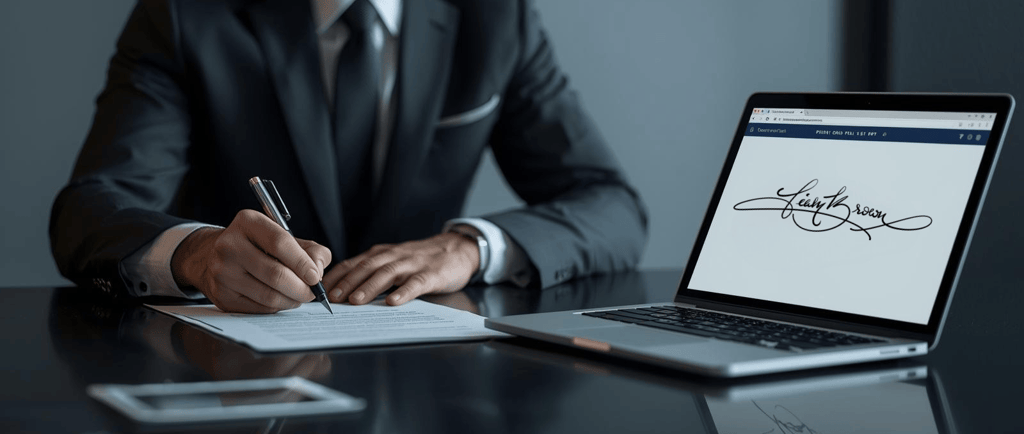
Handwritten digital signatures continue to dominate in 2026. Leaders want the personal authority of handwriting combined with the efficiency of digital workflows.
These signatures are designed specifically for digital use, ensuring they appear sharp and professional across:
Emails
PDFs
Contracts
Internal approval systems
The trend reflects a broader movement toward hybrid solutions that balance tradition and technology.
3. Consistency Across All Platforms
In 2026, consistency is no longer optional. Corporate leaders increasingly recognize that their signature should look the same everywhere it appears.
A consistent signature:
Strengthens recognition
Supports authenticity
Reduces confusion in audits or disputes
Reinforces executive authority
Custom-designed signatures make this consistency achievable across both physical and digital contexts.
4. Purposeful Design Over Habit
Leaders are moving away from signatures that exist purely by habit — marks developed quickly years ago and never revisited.
Instead, signatures are being treated as deliberate design choices, aligned with role, industry, and professional identity. This reflects a broader leadership trend toward intentional branding and thoughtful presentation.
5. Security-Conscious Design
With increased awareness of fraud and misuse, executives in 2026 are paying closer attention to signature security.
Secure signature design emphasizes:
Distinctive stroke patterns
Repeatable structure
Clear identifying features
These elements make signatures harder to replicate and easier to verify, supporting internal controls and professional accountability.
What’s Out: Signature Trends Fading in 2026
1. Overly Decorative Calligraphy
Highly ornate, elaborate calligraphy styles are becoming less common among corporate leaders. While visually impressive, they can appear outdated or impractical in modern business environments.
In fast-paced corporate settings, clarity and professionalism outweigh decorative flair.
2. Illegible Scribbles
Signatures that resemble rushed scribbles are increasingly seen as unprofessional. In 2026, illegibility is often interpreted as carelessness rather than efficiency.
Executives are expected to communicate clearly — and that expectation extends to their signature.
3. Typed Names as Signatures
Simply typing a name at the end of an email or document is rapidly falling out of favor in leadership contexts. While functional, typed names lack authority and personal presence.
In an era where leadership branding matters, typed names feel impersonal and incomplete.
4. Inconsistent Variations
Signatures that change significantly from one document to another are increasingly viewed as liabilities. Inconsistent signatures complicate verification, weaken trust, and introduce unnecessary risk.
Consistency is now a defining feature of professional signature design.
5. Poorly Scanned Images
Low-resolution scans, distorted images, and mismatched proportions are considered outdated in 2026. With modern tools readily available, such imperfections are interpreted as a lack of attention to detail.
Leaders are expected to present polished, technically sound signatures in all formats.
How Signature Trends Reflect Leadership Evolution
These trends mirror broader changes in corporate leadership. Modern leaders are:
More digitally fluent
More brand-aware
More security-conscious
More intentional about presentation
A signature, though small, encapsulates these values. It sits at the intersection of identity, authority, and technology — making it a powerful symbol of modern leadership.
Preparing Your Signature for the Future
For executives looking ahead, the question is not whether signatures still matter — it is whether their current signature aligns with modern expectations.
A future-ready signature should be:
Clear and confident
Consistent across platforms
Digitally optimized
Secure and distinctive
Aligned with professional identity
Custom design ensures these criteria are met intentionally rather than accidentally.
Why Corporate Leaders Are Choosing Custom Signatures
In 2026, more leaders are investing in custom signature design not for aesthetics alone, but for strategic reasons.
A professionally crafted signature:
Reinforces executive presence
Supports trust in high-stakes decisions
Enhances digital communication
Reflects modern leadership values
It is a subtle upgrade with long-term impact.
Ready to Align Your Signature with Modern Leadership?
Your signature appears on decisions that shape organizations — approvals, contracts, and commitments that carry real weight. It should reflect clarity, authority, and professionalism in every context.
If your current signature no longer aligns with who you are as a leader in 2026, a custom-designed signature can help bridge that gap.
Create your custom executive signature today and ensure your professional mark reflects the leadership standards of tomorrow.
Connect
Crafting unique signatures for every individual need.
© 2026. All rights reserved.